Why automotive automation is no longer being driven by ambition
Robot installations are hitting record highs, but for automotive tech businesses, the real commercial battleground is shifting to AI-driven quality, digital twins and the workforce that has to run it all.
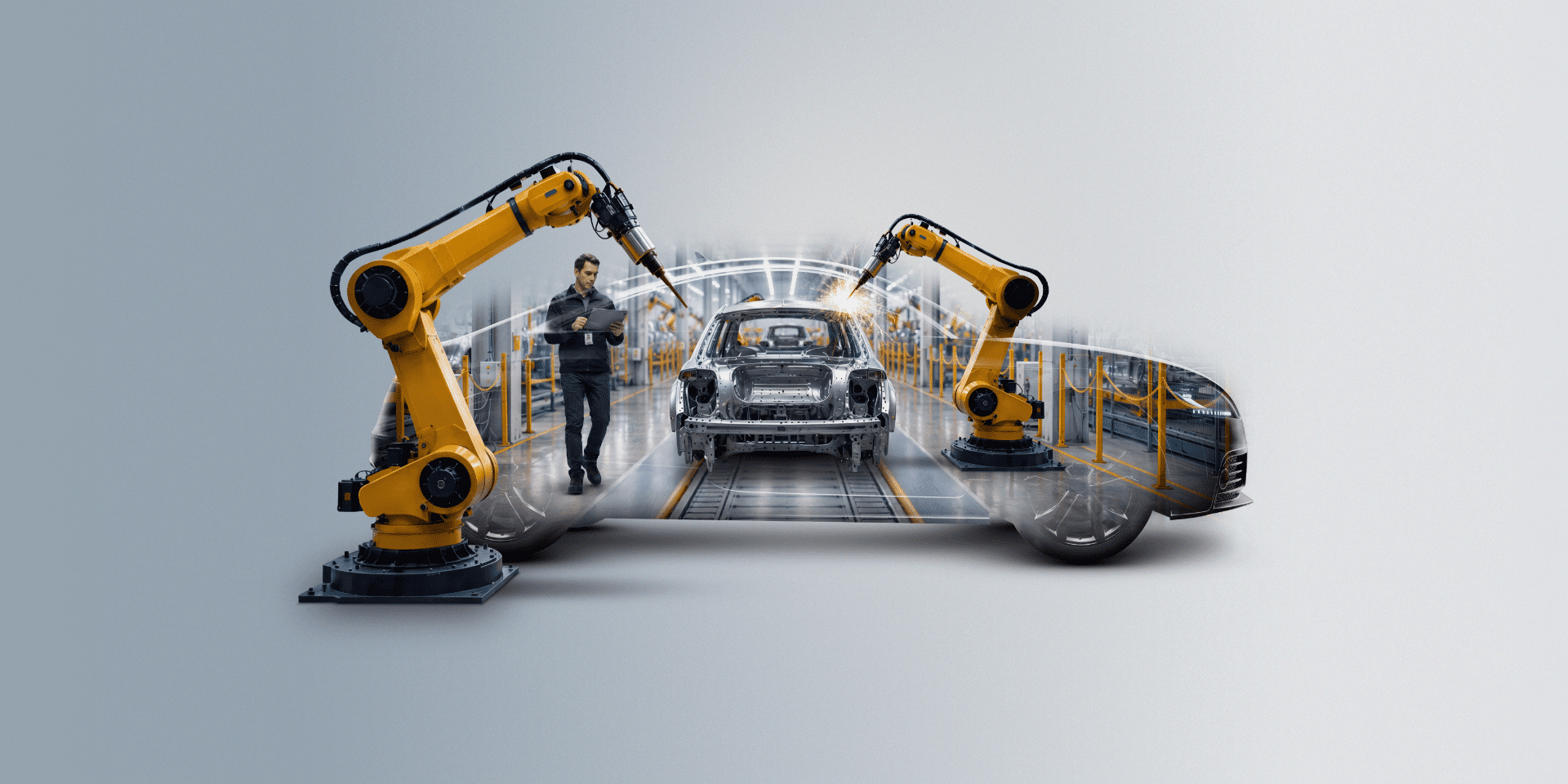
Automotive automation is still progressing fast, but the context is changing, and with it, who wins and loses across the supply chain. So, where’s the opportunity for automotive marketers right now?
Automotive manufacturing has been synonymous with the industrial robot for decades: it’s almost 50 years since Fiat ran their famous Handbuilt by Robots campaign.
But in many ways, the conversation has moved elsewhere. For the first time, in 2024 electronics overtook automotive as the world’s most robotised industry, with 128,899 units installed against a slight dip in new automotive deployments.
That’s because the real driver behind automated manufacturing right now isn’t ambition, it’s competition. AlixPartners’ 2025 Global Automotive Outlook found that Chinese automakers can develop new vehicles twice as fast as mass-market rivals, with 40 to 50% less investment and a 30% cost advantage, using radically simplified supply chains, gigacasting and vertically integrated production.
Some are taking new EVs from concept to production in as little as 18 months, against up to 45 months for established OEMs.
It’s that gap which is forcing legacy manufacturers and their Tier 1 and Tier 2 suppliers to put automation back in the spotlight. Not because it’s a novel technology that unlocks opportunity, but because standing still now carries a real commercial risk. So, where’s today’s innovation happening?

Where innovation is happening
AI-driven quality control and predictive maintenance are also on the rise, with Fortune Business Insights valuing the global predictive maintenance market at $13.65 billion in 2025, projected to reach $97.37 billion by 2034, as manufacturers move from scheduled servicing to systems that flag a failure before it happens.
Digital twins and simulation are arguably the least visible of today’s innovation categories, but the most technically demanding. The digital twin market in automotive alone is projected to grow from around $2.1 billion in 2024 at a compound annual growth rate above 30% through 2034. That’s a remarkable rate given the scale of the engineering challenge: modelling an entire production line accurately enough to test changes prior to investment.
Naturally alongside automation comes workforce transformation. But this isn’t a story of mass redundancy, far from it. Deloitte and The Manufacturing Institute estimate that US manufacturers could need as many as 3.8 million new employees by 2033, with 1.9 million of those roles going unfilled if the current talent gap isn’t closed. That’s an enormous training need – with demand for simulation and simulation-software skills having jumped by around 75% over the past five years.

What this means for automotive marketing
Because automated manufacturing is being driven by such competitive urgency, the commercial argument needs to change with it. This isn’t primarily a reliability story, it’s a speed story: how much a solution can compress design, validation and production cycles before the gap to the world’s fastest manufacturers becomes unrecoverable.
That reframes who needs convincing, and about what. Whilst boards and finance leaders need the business case put in terms of competitive risk (what happens if the business doesn’t automate), OEM engineering and procurement teams need hard proof of cycle-time and quality consistency at scale. And marketers mustn’t forget the importance of the workforce themselves, especially in markets like Germany where works councils have real influence over how automation projects get rolled out.
But the good news is that the stereotypical narrative that automation means more robots and fewer people doesn’t hold up. There’s a pressing need for skilled workers, and automation marketing must tell the story of how augmentation can help to address the hiring crisis and produce business value to boot.
The automotive marketers who get and stay ahead will be the ones who can convert technological innovation into pressing business need, cut through the complexity, and paint a credible picture about how their advancements can keep their customers in the race.